
We don’t find the good life. We cultivate it.
Cultivate. Like a garden.
You don’t plant a seed today and expect flowers tomorrow. You water, you prune, you wait, and you trust.
Some days, it rains too much. Some days, nothing seems to happen. And then one morning, you notice that the garden is just different.
Over the years, I’ve come to believe that our environment shapes us far more than our willpower ever could. And by environment, I mean more than just the physical spaces we inhabit. It is also how we spend our time, the work we do, the people we interact with, the routines we build, and the circumstances we repeatedly place ourselves in.
We often underestimate how much these everyday influences shape the way we think, feel, behave, and ultimately, experience life.
Sometimes, without quite realising it, we place ourselves in situations and circumstances where our lives, minds, and souls become increasingly cluttered. We accumulate responsibilities, expectations, commitments, relationships, and things to process.
What was once meant to be temporary gradually becomes our way of living.
For months. Sometimes, even years…..
We learn to function within the noise, and perhaps become remarkably good at managing it. So good, in fact, that we stop recognising it as noise.
Lately, I’ve come to appreciate something that once seemed almost indulgent to me:
Spaciousness
Not merely having free time on the calendar, but having room in my mind. The kind of room where there is nothing urgently demanding to be resolved, nothing emotionally complicated waiting to be untangled, and nothing constantly competing for my attention.
Where I can let my mind wander without needing it to arrive anywhere. Where creativity can flow, where I can reconsider and recalibrate, or simply rest.
Where there is nothing I need to process…
I’ve noticed that when our internal worlds become too cluttered, even beautiful things can begin to feel like demands:
An unexpected opportunity, an interesting person, an invitation to explore something unfamiliar. Things that might otherwise bring us joy can feel overwhelming simply because we have nowhere left to put them.
Sometimes, it isn’t that life has stopped offering us beautiful things but perhaps we have simply run out of space to receive them.
And I think that’s a quiet kind of loss.
On Designing a Life that Fits
I have come to think that, rather deliberately, I have designed a life with room.
Room for curiosity, spontaneity, creativity, connection, and the unexpected.
You meet someone interesting, you talk to them. You want to visit a place, you go. You feel like painting, you paint. You want to understand life a little better, you spend years trying to understand it.
We are all built differently. What feels exciting and fulfilling to one person may feel exhausting to another. Some thrive on structure, stimulation, and constant momentum. Others need flexibility, solitude, and uninterrupted stretches of thought. And perhaps this is where life design becomes a rather personal endeavour.
Neither is necessarily better.
Subscribing to Someone Else’s Life
Yet I wonder how much of our lives we spend subscribing to someone else’s understanding of what a good life ought to look like.
We design our calendars around obligations, our ambitions around external definitions of success, and our routines around what appears productive.
We become very good at asking ourselves what we should be doing, but perhaps less practised at asking whether the life we have built actually suits the person living it.
Our personalities. Our temperaments. Our values. Even our nervous systems.
I have noticed that my own nervous system seems to thrive in spaciousness. When there is room to move, when nothing feels perpetually compressed, and when I don’t have to constantly negotiate for emotional, mental, or logistical space, I feel more like myself.
I become more curious, more creative, more receptive, and perhaps even more generous with my attention.
It isn’t that life becomes free of responsibilities or difficult emotions. Rather, there is enough room to accommodate them without becoming entirely consumed by them.
Perhaps the more useful question isn’t always how we can become better at tolerating the lives we have built, but whether we could build lives that require a little less tolerance in the first place.
A Thousand Decisions
Life will always make demands of us, and not every circumstance is within our control. But I do think we have more authorship over the texture of our everyday lives than we sometimes recognise. The commitments we accept, the environments we choose, the people we make room for, and the things we decide no longer deserve our attention.
A thousand seemingly ordinary decisions that, over time, become the architecture of our lives.
Almost, in Bloom
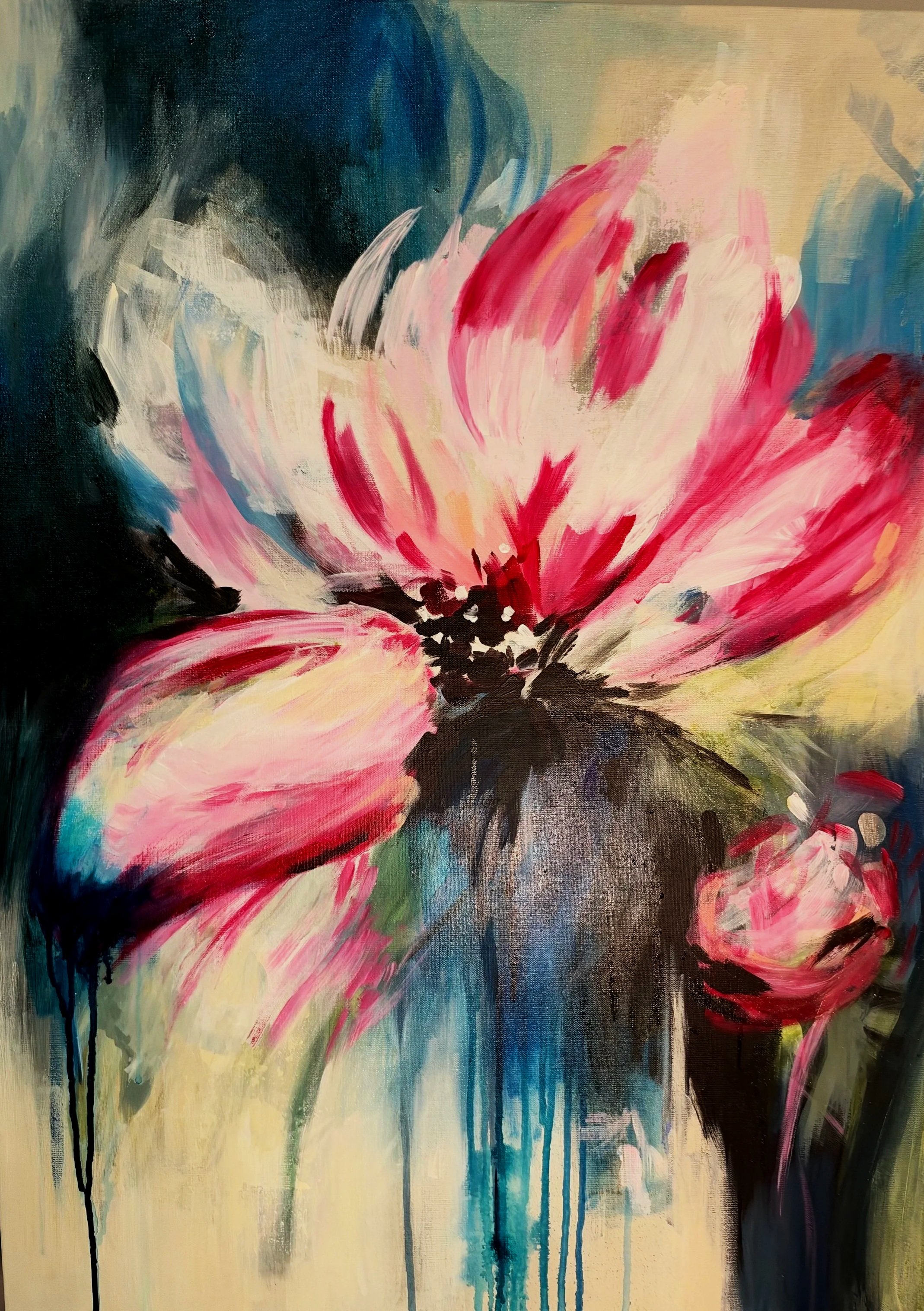
Almost, in Bloom (2026) | Acrylic on Canvas
There is something about this painting that feels particularly representative of this season. A flower, vibrant and expressive, seemingly trying to bloom. Its petals reach outward, almost exuberantly, yet its centre remains dense and tangled. Some parts appear to be emerging, while others seem to dissolve into their surroundings.
It is beautiful, but not entirely at ease.
It’s almost as though the flower possesses everything it needs to bloom, except the space to become what it could be.
And perhaps it is also struggling with the knowledge that blooming comes with impermanence.
Because to bloom is to become vulnerable. To open is to expose ourselves to the possibility of loss. And to experience something beautiful is sometimes to confront the fact that we cannot keep it forever.
I find myself wondering whether the flower needs more courage to bloom, or simply more room.
We often assume that when something isn’t flourishing, it needs more effort, more determination, or more courage. Yet sometimes, what is missing isn’t effort at all, but the conditions in which growth becomes possible.
On Cultivation and Letting Life Unfold
There is something quietly reassuring about the idea of cultivation. Unlike the pursuit of happiness as a destination, cultivation asks us to pay attention to the conditions in which something might grow.
We prepare the soil. We make room. We nurture what matters, and occasionally, we prune what no longer does.
But cultivation is not control:
A gardener can provide the most thoughtful conditions for a flower to bloom, but cannot command it to blossom on a particular morning. Nor can the gardener guarantee that every seed will flourish, or that every beautiful thing will remain.
We can deliberately cultivate the conditions for a good life without being able to determine every outcome within it. Some things flourish unexpectedly. Others never quite become what we imagined. Some experiences, relationships, and seasons of life are extraordinarily beautiful, but brief.
And I am beginning to think that knowing beautiful things do not always last need not diminish our willingness to welcome them.To appreciate what is here, while it is here, without turning every uncertainty into something that must be resolved.
The “Good” Life, Quietly
I don’t think happiness arrives as a destination. At least, it hasn’t for me.
More often, it has arrived quietly, disguised as a thousand ordinary decisions that honoured the person I was becoming.
And perhaps, the “good” life was never meant to have a universal definition. What feels meaningful today may look entirely different in another season.
Like a garden, life unfolds in seasons. Some things bloom spectacularly and briefly. Others grow slowly and stay for years. Not everything we nurture will last, and not everything beautiful is ours to keep
But perhaps that was never the point of cultivating a garden.
We tend to it because, while it is here, it is alive
And so are we, even if it’s only for a while
